NVS Examination


Upcoming Examination Dates:

October 8-14, 2026: Registration coming soon!

February 11-17, 2027: Registration coming soon!


Register to take the exam at any time for an additional $100:

Coming soon!

Registration Rates:

ASN Member: $225

Non-Member: $275

Exam Information

Frequently Asked Questions

  • How can I submit a question for the exam?

    Please complete this form. 

  • Is ASN membership required to obtain certification?

    Yes. To maintain your NVS credential, you are expected to be a member in good-standing of ASN. 

  • Do I have to take all three parts of the exam? Physics, TCD, and Carotid?

    No. If you have your ARDMS, CCI, ARRT (VS), the physics portion of the exam is waived. You must submit documentation with your application.


  • What is the cost to re-take the exam?

    Member - $225

    Non-member - $275


  • If a person is taking (not a re-take) only part of the exam because they passed the other two parts in the past, do they need to resubmit verification of CME within the last 3 years?

    No, since they had enough CME hours at the time they took the exam initially, they do not need to submit documentation of CME within the last three years. They do, however, need to submit documentation verifying their interpretation of whatever section they are taking (Carotid or TCD).


  • Is a physician eligible to sit for the exam if they meet all other criteria?

    Yes.

  • Do CMEs need to be neurology specific or can they be any type of ultrasound (e.g. nerve and muscle CME)

    Pertinent CME needs to be something related to neurovascular ultrasound (physics, principles, techniques, clinical applications, quality improvement for lab, lab accreditation, etc) in order to qualify.  This is consistent with the definitions use by IAC-Vascular Testing when evaluating CME for medical directors or medical staff applying for accreditation of their carotid or TCD labs. 


  • Can a person only pass one part of the exam and still be certified in the section that they passed?

    No. A person MUST pass physics AND one additional part of the exam to be considered certified. If the physics portion is waived, they must still pass one additional part of the exam.

  • Can one count CME from a larger meeting if it is related to neurovascular ultrasound?

    It will depend on what portion was related to ultrasound or lab function.  It is often necessary to have them send in a list of the topics (copy of the program) for a meeting to document which are appropriate, if they wish to count CME from a larger meeting.


  • If one does not have enough CME at the time they apply to sit for the exam, and they plan to attend the ASN Annual Meeting to obtain the rest of their required CME credits, is that acceptable?

    Yes. They must include a statement in their application materials stating that this is what they plan to do, and their certificate is mailed to them only after we receive their CME documentation from the meeting.

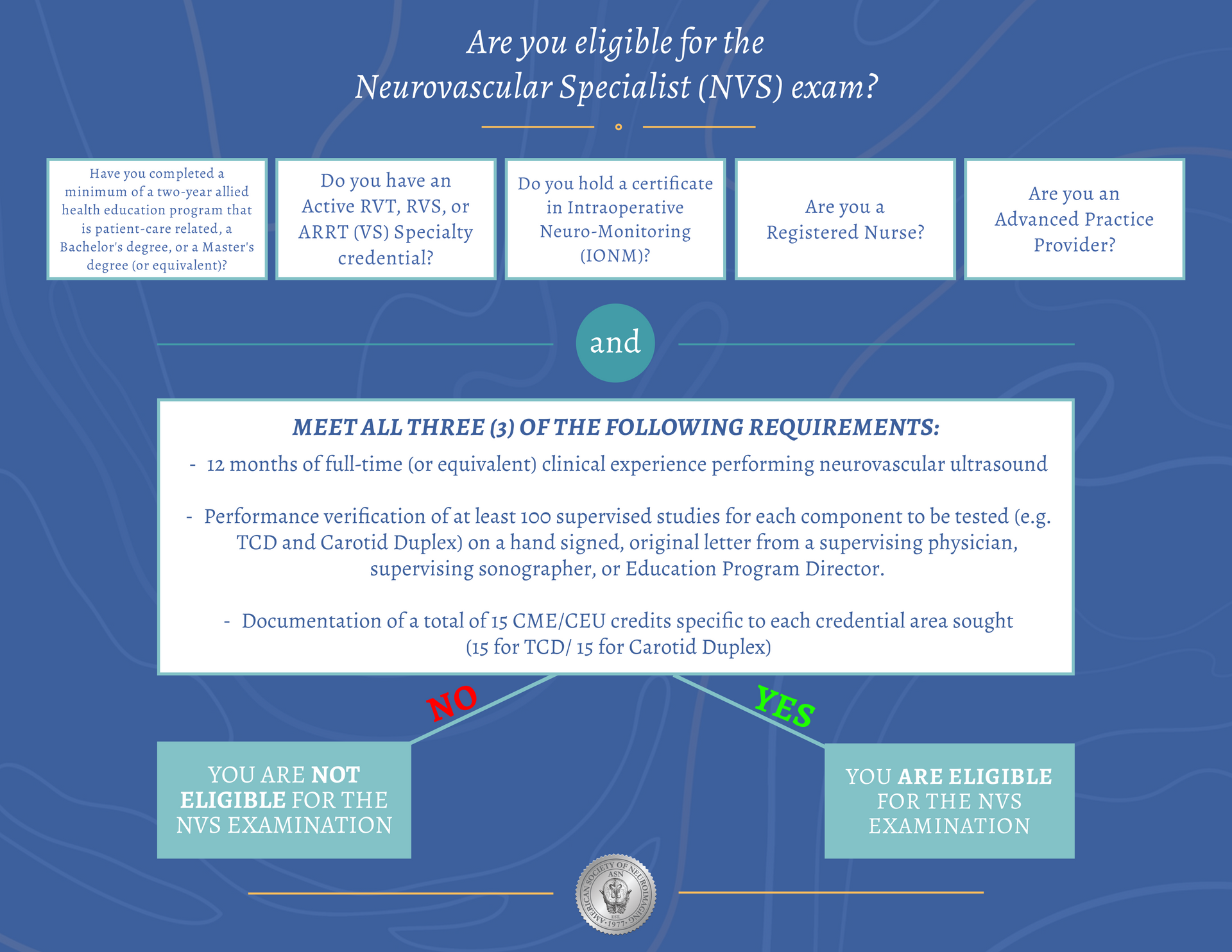
  • How does an exam applicant show verification of their 100 TCD/Carotid interpretations? Do they need to submit documentation of each case? Does the supervising individual need to be an MD that is certified by ASN?

    No, we do not require submission of individual case interpretations. Instead, applicants must provide a letter from their supervising physician confirming that they have completed at least 100 interpretations. “Adequate supervision” refers to the standard oversight structure in place within a laboratory that employs appropriately credentialed personnel. Applicants are not required to come from ICAVL-accredited laboratories, nor must their supervisors be ASN-certified.


    ASN will accept studies performed by the applicant, provided it is clearly documented that the applicant conducted the test and prepared a preliminary report, which was subsequently reviewed by a credentialed MD at the facility. ASN certification of the reviewing physician is not required. The preliminary report serves as evidence that the applicant independently interpreted their studies. Supervision by a chief technologist is also acceptable, as this reflects standard laboratory practice in which the preliminary report is reviewed and approved by the most experienced staff member before final physician interpretation.

  • Can CME credits older than three years be used towards sitting for the exam or maintenance of certification?

    Generally, no. If there seems to be a special circumstance or extenuating situation then this may be considered.

  • Aside from the ASN Annual Meeting, where else can I earn relevant neurovascular CME credit?


  • What are the time frames for each exam section?

    TCD Only - 240 mins

    Carotids Only - 240 mins

    Physics & Carotids - 240 mins

    Physics & TCD - 240 mins

    Physics, Carotids & TCD - 240 mins

  • Will a UCNS fellowship in Neurocritical Care (or other neuro subspecialty) satisfy the fellowship requirement for the Neurosonology Exam?

    The answer depends on your fellowship curriculum. If your fellowship provides you with an opportunity to learn TCD at least for SAH and brain death, and you either performed or interpreted TCDs for these or other indications under supervision and continuously thru fellowship, this would qualify you to register for the exam.


    Your fellowship director simply needs to state in the letter that learning TCD is included into your fellowship curriculum. One needs to have an in depth exposure to TCD (exam is tough on physics and hemodynamics).


  • What title do they hold for passing the ASN Exam?

    This is not a board exam, so does not allow one to claim to be a “diplomate”.  It is also not an accreditation process, which is left to IAC-Vascular.  It is a certification exam, so all one can really say is that one is has successfully completed/passed the ASN Neurosonology Certification Exam, is certified in Neurosonology, or has an additional credential in Neurosonology (with specific TCD or carotid if only one or the other).  

  • What is the correct wording for exam certificates?

    All three parts: Basics of Ultrasound and Ultrasound Physics, Carotid Duplex, Transcranial Doppler

    - Two parts: Basics of Ultrasound and Ultrasound Physics, Carotid Duplex

    - Two parts: Basics of Ultrasound and Ultrasound Physics, Transcranial Doppler